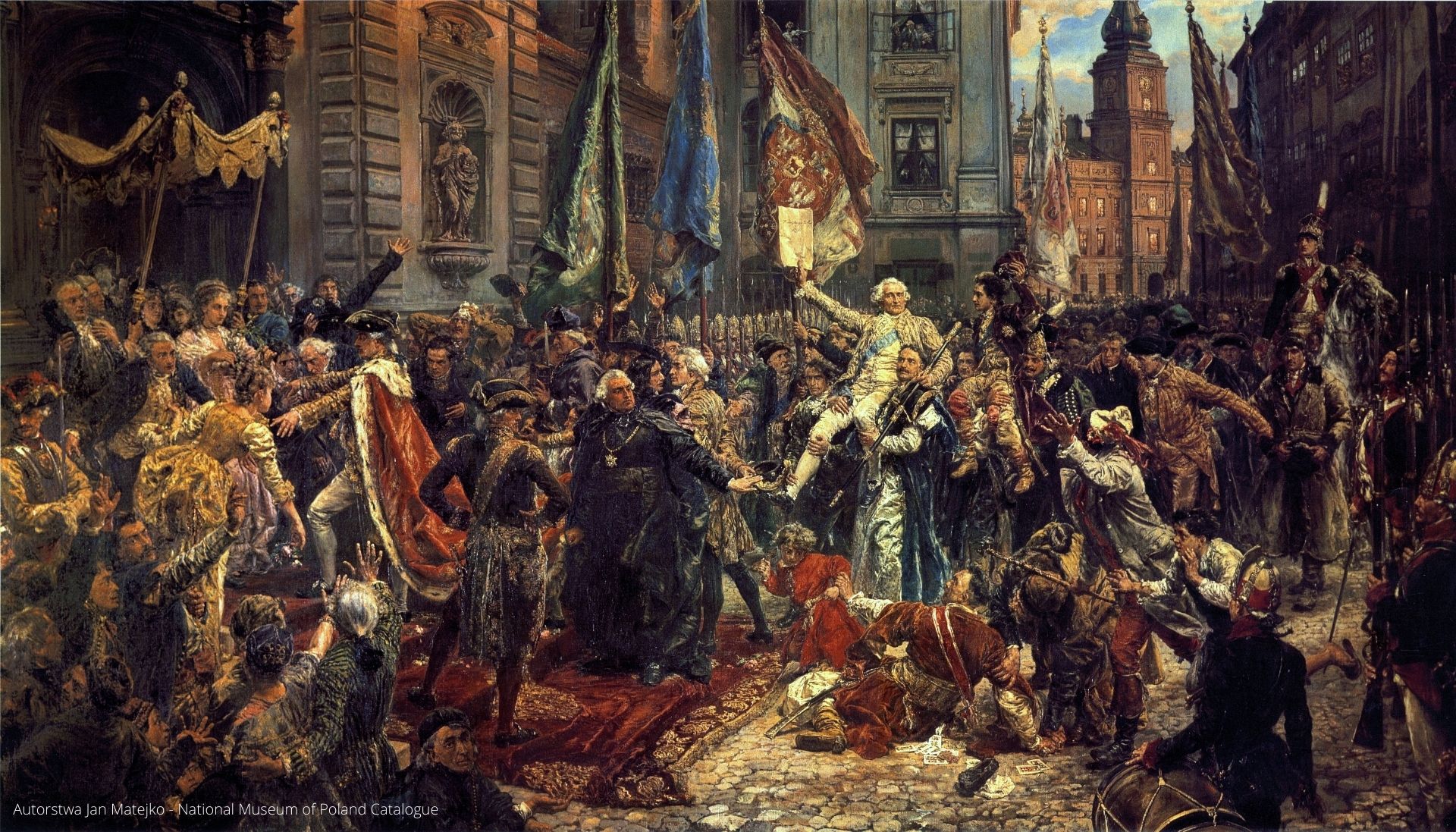
Constitution of May 3rd – Celebration
WHEN
- Tuesday, 21 April 2026
WHERE
- By invitation only
We are pleased to announce the upcoming celebration of the 3rd of May, the anniversary of adopting the Polish Constitution – an occasion of great historical significance and national pride.
This special event for distinguished guests, will offer a refined and reflective atmosphere to honor this important day. The program will include a short artistic performance by pianist Krzysztof Moskalewicz, whose music will provide an elegant and memorable highlight of the evening.
We look forward to sharing excerpts from this celebration.
Quick Read – 3rd May Constitution
The Constitution of May 3rd was the first written national constitution in Europe and the second in the world after the U.S. Constitution.
Poland is a pioneer of European constitutionalism. In 1791 the King and the Parliament of the Commonwealth of Poland and Lithuania have enacted Europe’s first written national constitution, later called the Constitution of May 3rd. Poland’s current constitution was adopted by the National Assembly of Poland on 2 April 1997. The Constitution provides for the foundations of Poland’s socio-political system. It also guarantees the basic personal, political, economic, social and cultural rights of its citizens.
THE ARTIST

Krzysztof Moskalewicz
Pianist
Krzysztof is an artist of exceptional sensitivity, whose interpretations are marked by natural expression and profound emotional depth. Equally passionate about solo and collaborative performance, He has performed as a soloist and chamber musician at many prestigious venues.
Krzysztof’s musical journey began at the age of seven, under the tutelage of Renata Lasocka. In 2011, he graduated with honors from the Fryderyk Chopin State Music School in Warsaw, where he studied with Joanna Kurpiowska. He furthered his education at the Guildhall School of Music & Drama, earning a Master’s degree with distinction in 2017 under the guidance of Ronan O’Hora and receiving the prestigious Guildhall Artist Fellowship. He also completed a Professional Diploma at the Royal Academy of Music, studying with Ian Fountain.
PARTNERS

VENUE

History of the 3rd May Constitution
When on 3 May 1791 the Four-Year Sejm also called the Great Sejm adopted The Government Act of the Polish–Lithuanian Commonwealth later known as the Constitution of 3 May, the Polish-Lithuanian state became Europe’s first and the world’s second that passed the basic law.
For its time, it was a progressive and bold legal act that initiated a number of reforms. It also constituted a crowning achievement of the centuries-old links between Poland and Lithuania.
The 3rd May Constitution introduced, among other things, the principle of the tripartite separation of power, and reformed the existing political system ensuring more equal treatment of all nationalities within the Commonwealth. It also expressed the nation’s will to defend Poland’s independence following its first partition by Austria, Prussia and Russia in 1772.
The Constitution of 3 May along with its complementary Reciprocal Guarantee of Two Nations adopted by the Great Sejm on 20 October 1791 also confirmed a closer union between the Polish and Lithuanian nations.
The act ensured equal 1 to 1 representation at the Commonwealth’s shared state bodies for Poles and Lithuanians. We can proudly say that the leaders of the two nations and states, despite all differences, could work together effectively at a crucial moment for their existence. Such an example has been inspiring cooperation and friendship between Warsaw and Vilnius to date.
Unfortunately, the ambitious reform plans which had been meant to be implemented based on the new constitution were shattered by the Russians’ armed intervention in 1792. As a legal act, the Constitution of 3 May formally ceased to be in force in November 1793 by virtue of the resolution by the Sejm that was summoned under the dictate of Russia and Prussia in Grodno.
On the same year, the two states partitioned Poland for the second time.
Finally, the Polish-Lithuanian state disappeared from Europe’s map for over 120 years after the 3rd Partition in 1795 conducted by Austria, Prussia and Russia. This act, violating all principles of international law, was erased only after World War I when Poland and Lithuania regained independence as two sovereign states.
When Poland regained its independence, the anniversary of adopting the 3 May Constitution was celebrated as a national holiday since 1919. Under German and Soviet occupation as well as under the rule of communist authorities in Poland, when the 3 May Day holiday was banned, most Poles continued to observe it. In the sovereign Republic of Poland, we have been celebrating May 3 National Holiday again since 1990.
