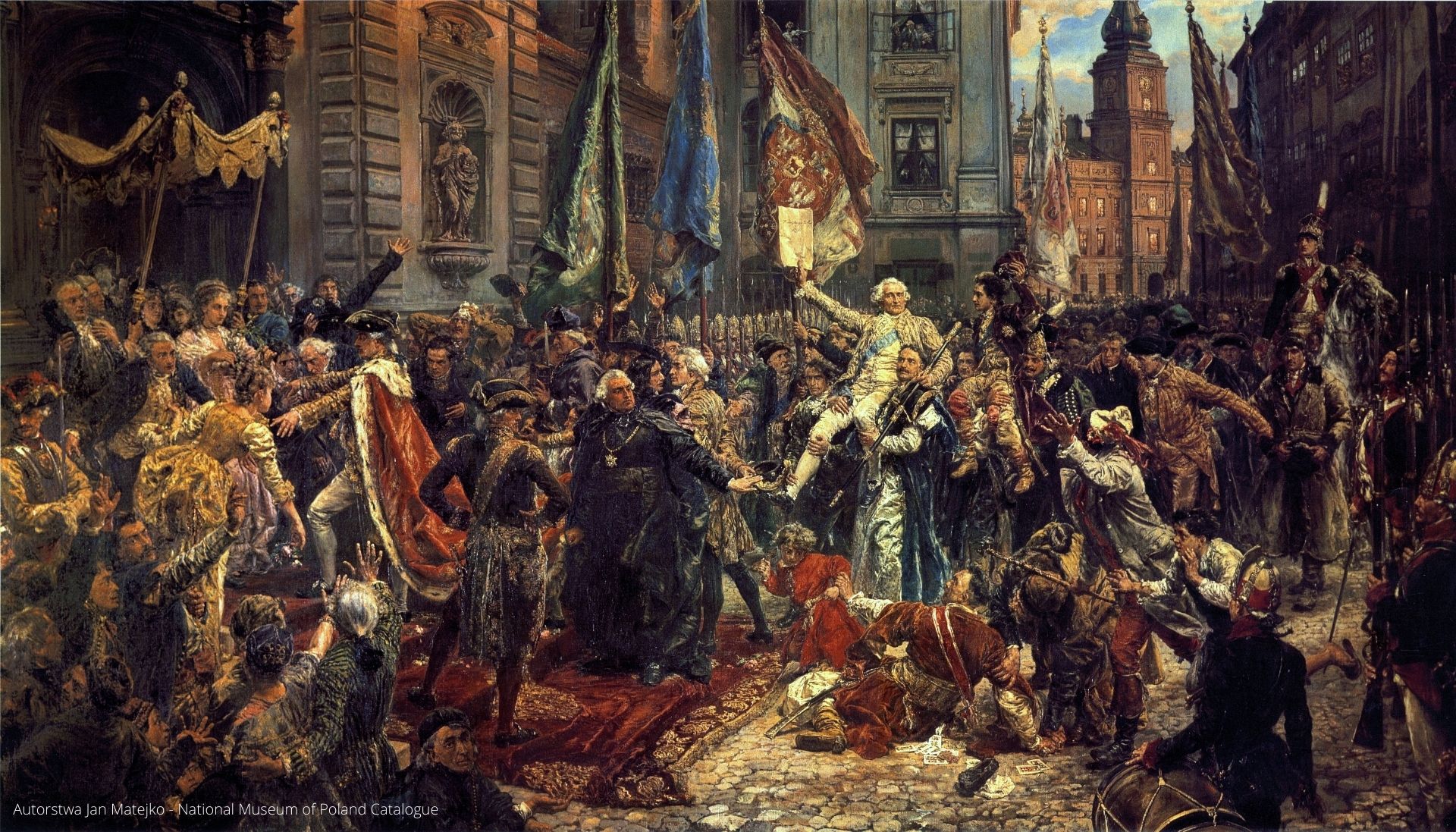
History of the 3rd May Constitution
WHEN
- READ ONLINE
The Adoption of Europe’s First Modern Constitution
On 3 May 1791, the Four-Year Sejm, also known as the Great Sejm, adopted The Government Act of the Polish–Lithuanian Commonwealth, later known as the Constitution of 3 May. With this historic decision, the Polish–Lithuanian Commonwealth became the first country in Europe and the second in the world to adopt a written constitution.
For its time, the Constitution was a bold and progressive legal act. It launched a series of important reforms and marked the culmination of centuries of political cooperation between Poland and Lithuania.
Key Reforms and Principles
The Constitution of 3 May introduced the principle of the separation of powers and reformed the existing political system. It promoted more equal treatment of all nationalities within the Commonwealth. The document also expressed the nation’s determination to defend Poland’s independence after Austria, Prussia, and Russia carried out the First Partition of Poland in 1772.
On 20 October 1791, the Great Sejm adopted the complementary Reciprocal Guarantee of Two Nations. Together with the Constitution of 3 May, this act confirmed a closer union between the Polish and Lithuanian nations.
Polish–Lithuanian Cooperation
The new legislation guaranteed equal 1-to-1 representation for Poles and Lithuanians in the Commonwealth’s shared state institutions. Despite their differences, the leaders of both nations worked together effectively at a crucial moment in their history. Their cooperation remains an inspiring example for relations between Warsaw and Vilnius today.
The Fall of the Reform Movement
Unfortunately, Russia’s armed intervention in 1792 brought the ambitious reform programme to an end before the authorities could fully implement it. In November 1793, the Constitution of 3 May formally lost its legal force after the Sejm in Grodno, convened under pressure from Russia and Prussia, passed a resolution to that effect.
Later that same year, Russia and Prussia carried out the Second Partition of Poland.
The End of the Commonwealth
In 1795, Austria, Prussia, and Russia conducted the Third Partition of Poland. As a result, the Polish–Lithuanian Commonwealth disappeared from the map of Europe for more than 120 years. This violation of the principles of international law ended only after World War I, when Poland and Lithuania regained independence as two sovereign states.
The Legacy of the 3 May Constitution
After Poland regained independence, the country began celebrating the anniversary of the Constitution’s adoption as a national holiday in 1919. During German and Soviet occupation, and later under communist rule in Poland, the authorities banned the 3 May holiday. Nevertheless, most Poles continued to commemorate the occasion.
Since 1990, citizens of the sovereign Republic of Poland have once again officially celebrated 3 May as a national holiday.
Discover how the Polish community and friends of Poland celebrated the Constitution of 3 May in Singapore this year -> Constitution of May 3rd – Celebration
